The Heath
Handling the UndeadThe Heath is an unfinished housing development turned into an improvised settlement and, during the crisis, a place of intensifying collective terror. Its empty buildings and failed infrastructure are not merely a backdrop: the neglect that leaves it outside ordinary city life also shapes how its residents survive, how outsiders approach it, and how it is ultimately sealed off.
Setting and physical character
Flora reaches The Heath on foot after getting off a bus at Tensta centrum, walking about a kilometre along the Akalla path and then crossing open ground where the only remaining tracks had been left by construction machinery years earlier. Near dawn, she looks down from a hill at the grey buildings. The view contrasts with her earlier visit, made at night in the spring: then the city had been visible only indirectly, suggested by a change in the surrounding sounds; now the approaching daylight picks out the buildings and the few windows that remain unbroken.
The development was never completed. Street lighting and working lights in the windows are absent, and water, electricity, and drainage were never brought all the way to the site. The lack of planting is just as noticeable: there are no trees or bushes, and no birds or rustling leaves to interrupt the human sounds. From Ekvatorvagen, Flora hears only people—voices and cries—before turning onto Latitudvagen and reaching Peter’s courtyard. Broken glass underfoot echoes between the bare concrete walls. The buildings rise three storeys, and a large central structure was intended to combine a laundry, social space, and refuse centre; without water, rubbish collection, or any desire for communal gatherings, its planned functions have come to nothing.
Failed development and civic neglect
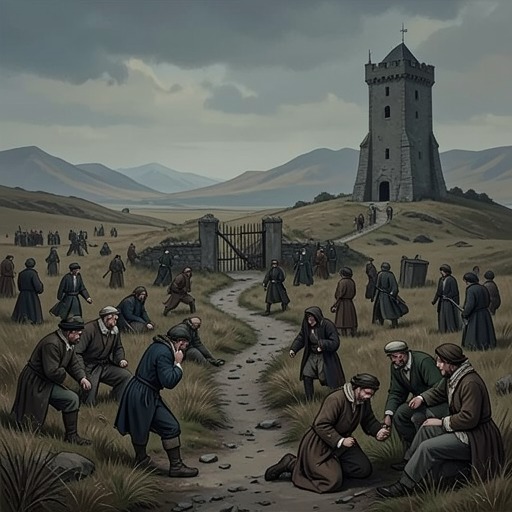
Until a few years before Flora’s visit, the area was theoretically still a construction site and had been enclosed by a fence. Residents repeatedly made new entrances, and the boundary eventually ceased to be maintained. Much of the fencing was taken for other uses; the remainder lay scattered in the grass. The abandoned perimeter gives a physical form to the development’s unsettled status: it was designed as a regulated project, but neither completion nor effective control followed.
Responsibility for demolishing The Heath had been contested in a court case for five years, and no one was willing to act while the case remained unresolved. The stalled dispute left a conspicuous mark on the city: a failed, somewhat disreputable project that had become a gathering place for people displaced from elsewhere. Graffiti-cleaning crews had long since stopped trying, and the lower parts of the buildings accumulated both spikes and artwork. Police occasionally entered to clear the site, but the lack of resources to deal with what followed meant that they preferred not to concern themselves with it. The Heath’s deterioration is therefore presented not as a sudden disaster but as the cumulative result of unfinished construction, unresolved responsibility, and intermittent enforcement without a workable response.
Improvised refuge and daily life
The site’s emptiness does not mean that it is unoccupied. Its buildings and courtyards have been adapted to needs they were never designed to meet. Peter lives in a concealed room behind a wall mural, in a divided section of a ground-level space originally intended for bicycle storage. The intact reinforced-glass window would take effort to break, while the hidden entrance and the cursory nature of Police searches have helped him avoid eviction during clear-outs.
The space behind the mural is only six metres square. Peter has fitted it with a bed salvaged from a skip and carried home on his moped, a chair, a table, a kerosene stove, and a container of water. His bicycles and delivery moped occupy the room outside. A boombox runs from a car battery; an electric toothbrush, a razor, a Gameboy, an alarm clock, and a mobile phone sit alongside these makeshift arrangements. A flashlight is an exception to his self-contained setup, and Flora usually brings him batteries. The small room turns the larger development’s failures into immediate practical conditions: electricity must be stored, water carried, and even a hidden home depends on what can be salvaged or brought in.
Enclosure and the crisis
When Flora returns during the crisis, The Heath is being transformed from an open, neglected site into a restricted area. At 12:15, she arrives hoping to get inside, but she has a different surname from her grandfather and no proof of her status. She had called Elvy that morning for a signed document, only to be told that Elvy was busy. Peter, meanwhile, has remained hidden through the clear-out; the previous evening his battery went flat, and the activity in the area makes it impossible for him to get to a source of electricity.
The speed and scale of the operation are striking against the site’s years of abandonment. Peter has reported military personnel swarming over the area, with work continuing around the clock. At least three kilometres of fencing have been erected in two days. The press has either been kept out or reached some arrangement, and nothing about The Heath appears in the news until the Prime Minister makes an announcement. The sudden capacity to secure the place contrasts with the long failure to finish, maintain, or resolve responsibility for it.
At 12:50, as Flora walks toward the buildings, she feels the field grow stronger. What had seemed like streams passing through her head outside the gates becomes, within the area, a thickening fog. Individual thoughts can be heard faintly, and the collective presence of many consciousnesses is accompanied by mental exclamations of horror that intensify the field. The site’s architecture—bare walls, enclosed spaces, and courtyards—now contains an experience that presses in on those who enter. At 13:15, Flora lies curled on a bench, clutching her backpack and unable to move while the world seems to explode around her. The Heath will never again be open to the public. Its final change is from an abandoned development that residents repeatedly entered and inhabited into a place permanently closed after the crisis, its earlier neglect giving way to forceful containment.